
 EN
EN


Explore rough-terrain forklift types, 3-10 t capacity references, working scenarios and the key checks for choosing a configuration for your site.
FANGSHENG content team · 29 September 2026
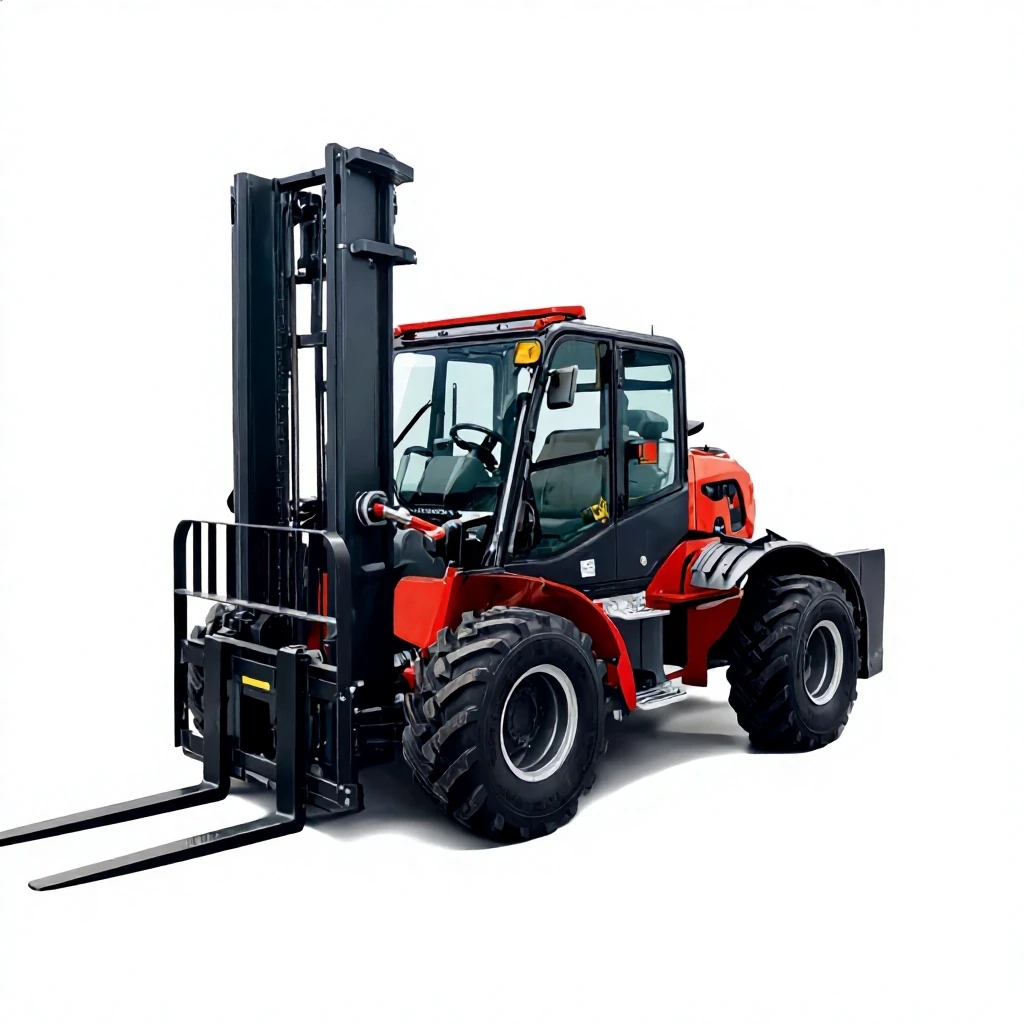
An off-road forklift, also called a rough-terrain forklift, is designed for material handling beyond a smooth warehouse floor. It can be considered for outdoor yards and work areas where the ground surface, access and load-handling requirements differ from indoor operations. The right choice depends on more than large tyres: capacity, load centre, lifting height, traction and site conditions all matter.
This guide explains the main equipment types, the capacity references in the FANGSHENG range, typical applications and the information to prepare before requesting a quotation.
What makes a forklift suitable for rough terrain?
Rough-terrain machines may combine increased ground clearance, pneumatic tyres with an outdoor tread pattern and a drive system selected for uneven surfaces. Features differ between models; four-wheel drive, differential locks, steering arrangements and tyre specifications should be checked on the proposed machine rather than assumed from its appearance.
For example, LiuGong's rough-terrain forklift description identifies ground clearance, 4WD transmission and differential locking as features of that specific model. These are useful comparison points, not specifications that automatically apply to every off-road forklift.
Rough-terrain capability does not mean unrestricted access to deep mud, unstable ground or steep slopes. The machine's operating manual, load chart and the condition of the working area remain decisive.
Main types: mast forklifts and other handling options
Vertical-mast rough-terrain forklifts use a mast to lift loads close to the front of the machine. For buyers mainly moving pallets between ground level, storage positions and loading areas, this is the main type to compare. Check mast height when lowered, lifting height and visibility around the load.
Within mast-type ranges, manufacturers offer different drive and chassis configurations. A 2WD model and a 4WD model should be compared against the actual route, ground condition and traction requirement. Ask the supplier to identify the drive system and steering arrangement in writing. Paint colour is not an equipment type and does not establish capacity.
Telescopic handlers are a separate option when forward reach is central to the task. Their boom reaches outward as well as upward, and the permitted load changes with boom position. Do not treat a mast forklift and a telehandler as interchangeable merely because both can carry forks. Manitou's agricultural telehandler range illustrates this different equipment family. A telehandler is discussed here for comparison; it is not presented as part of FANGSHENG's current off-road forklift listings.
Tonnage: how to read the FANGSHENG product range
In this guide, one tonne (t) means 1,000 kg. The website currently includes source-listed capacity references from 3 t to 10 t, with some listings describing alternative configurations. These are starting points for an enquiry, not a single load chart covering the entire range.
- 3 t and 3.5 t: a starting range to investigate for palletised building materials, agricultural supplies and general outdoor handling when the actual load and lifting requirement fit the confirmed specification. See the 3 t red off-road forklift and 3.5 t blue off-road forklift.
- 5 t and 6 t: references to discuss when the intended loads exceed the smaller configurations. Compare machine dimensions, turning space, ground support and the capacity at the required lift height. See the 5 t off-road diesel forklift and 6 t red off-road diesel forklift.
- 8 t and 10 t: heavier-capacity references for buyers with a clearly defined load-handling requirement. Confirm both the load chart and whether the site can support and accommodate the complete machine-and-load combination. See the 8 t listing and 10 t listing.
- Listings labelled 3-4 t or 3-3.5 t describe capacity options in the source material. Ask for the exact ordered configuration; the range is not permission to vary the rated load of one machine.
Why rated capacity is only the first check
A capacity figure is associated with specified conditions. Load centre, lifting height and an attachment can change what the truck is permitted to handle. A long timber bundle and a compact pallet of the same mass may therefore require different checks. Attachment weight and the way it positions the load must also be considered.
Use the manufacturer's capacity plate and load chart for the exact truck, mast and attachment combination. Do not estimate an allowable load from a product photograph. OSHA's guidance explains load composition and load centre and the effect of attachments on capacity.
Typical applications and the questions each site raises
Construction and building-material yards: pallets of bricks, bagged materials and timber packs create different load shapes. Record the package weight, fork entry dimensions, unloading height and narrowest access point. A site photograph can help explain the route, but it does not replace a ground-condition assessment.
Farms and agricultural supply yards: discuss the size and mass of the materials to be handled, seasonal ground conditions, barn clearance and any proposed attachment. Confirm compatibility rather than assuming a standard fork carriage accepts every farm implement.
Timber yards and sawmills: long loads need particular attention to load centre, lateral clearance and load restraint. Provide bundle length as well as weight when requesting a recommendation.
Outdoor industrial storage and rental operations: compare the space available for turning and stacking, transport dimensions and the range of loads expected during use. If one machine will serve several sites, describe the most demanding conditions, not only the easiest yard.
These application categories are also reflected in Manitou's rough-terrain forklift range. The suitability of a specific FANGSHENG configuration must be confirmed for the intended task.
Mast, tyres, engine and attachments: what to compare
Mast: request the full lifting height, lowered mast height and any free-lift requirement. A taller mast is useful only if the machine still fits through the required doors and retains sufficient capacity for the load.
Tyres and traction: specify whether the route is paved, compacted gravel or another prepared surface. Ask for tyre size and type, drive configuration and operating limits. Tyre tread alone does not establish safe performance on a particular site.
Power system: several current listings specify diesel. Confirm the exact engine, service requirements and destination-market documentation in the quotation. For indoor or enclosed tasks, assess ventilation and select equipment suitable for that environment.
Attachments and cab: ask about the required forks, side shift or other attachment, and any weather protection needed. Availability and approval are configuration-specific. An accessory shown in a gallery should not be assumed to be included in the price.
A practical enquiry checklist
Send FANGSHENG the following information to make quotations easier to compare:
- Maximum load weight, package dimensions and load centre if known.
- Required lifting height and the height of the loading or stacking position.
- Ground surface, gradients and photos of the working route.
- Narrowest access width, lowest overhead clearance and turning space.
- Preferred drive system, mast, tyres, cab and approved attachments.
- Daily workload, order quantity and destination country or port.
- Required documents, packing, spare parts and after-sales support scope.
Ask the quotation to identify the precise product reference and configuration. Confirm lead time, freight scope and warranty terms before placing an order.
Frequently asked questions
Is every off-road forklift four-wheel drive?
No. Check the specification of the proposed model. Many FANGSHENG listings state 4WD or 4x4, but this should not be assumed where the listing does not identify the drive system.
Can a 3.5 t forklift lift 3.5 t at any height?
No. The allowable load depends on the rated conditions and the actual configuration. Check the load chart at your required height and load centre, including any attachment.
Is a larger-capacity machine always the better choice?
No. A larger machine may require more space and greater ground support. Select the configuration that meets the complete task, including access, turning, transport and maintenance requirements.
Can I choose a model just by its colour or gallery image?
Use the product reference and written specification. Gallery images may show configuration variations, and colour alone does not identify the engine, mast or capacity.
Find an off-road forklift for your site
Browse the FANGSHENG off-road forklift range and send us the product reference with your load and site requirements. We can discuss the proposed configuration and the details needed for a quotation.
Request a quotation or contact fangshengzb@gmail.com. Phone / WhatsApp: +86-19565637823.
Prepared by the FANGSHENG content team. Published 29 September 2026. Product information is based on the website listings available on that date; the final quotation and machine documentation define the supplied specification.